
Nepal’s Floods, KwaZulu-Natal’s Scars: A Wake-Up Call For Travellers And Tourism
On the morning of 26 August 2026, an ice and rock avalanche broke loose from a glacier above the Lende Khola in Nepal’s Rasuwa district. Within minutes it had swollen into a flash flood on the Bhote Koshi River, tearing through the villages of Syapru Besi and Timure, destroying roads, bridges and hydropower stations, and sweeping away hundreds of people, many of them foreign tourists and pilgrims. It is the second time in fourteen months that this same stretch of river has flooded. For travellers planning trips abroad, and for KwaZulu-Natal, a province that knows exactly what a flood like this costs, it is a disaster worth sitting with for more than a news cycle.
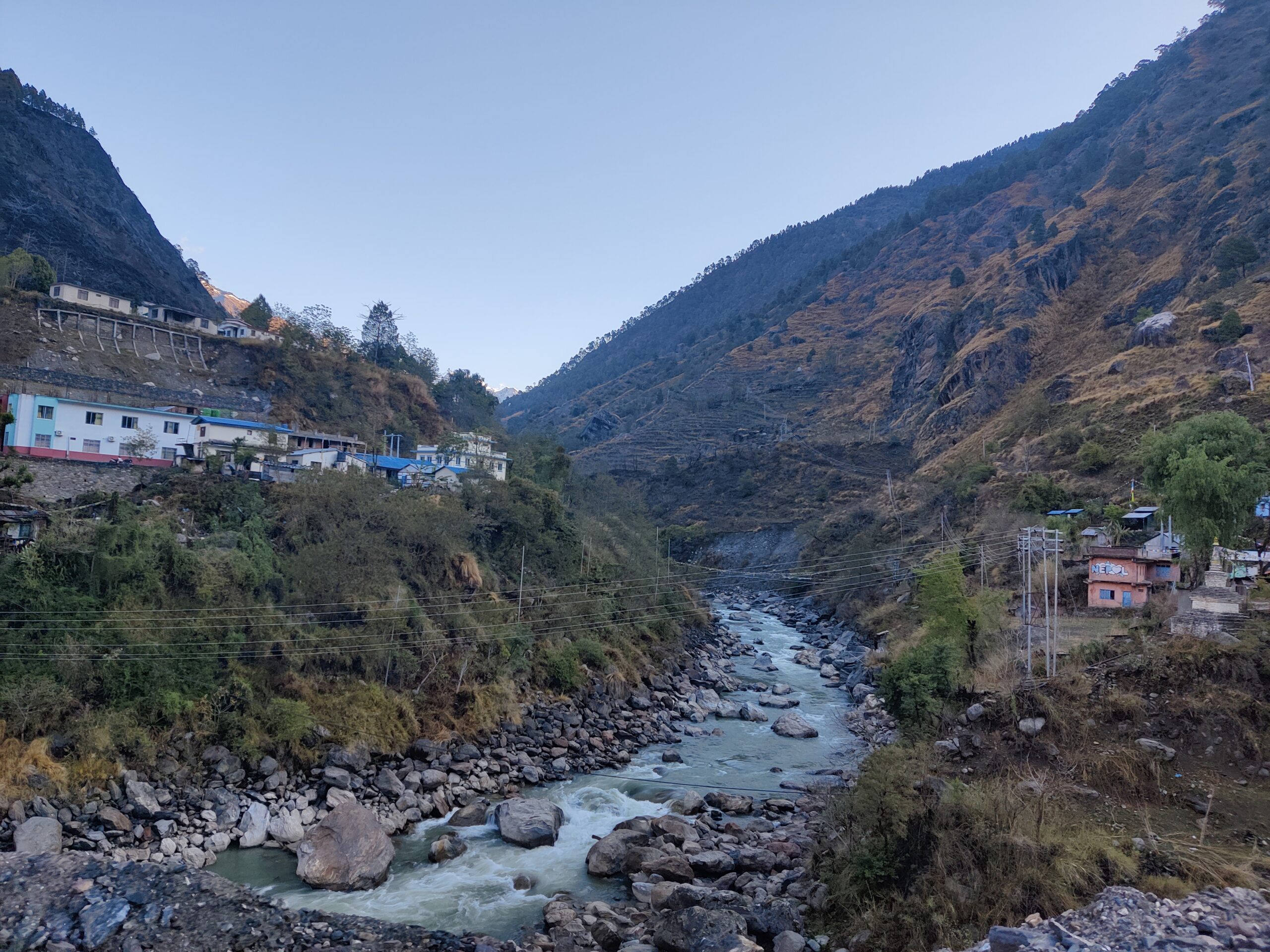
Photo: Pustam.EGR / Wikimedia Commons (CC BY 4.0) — the Langtang Khola near Syapru Besi, Rasuwa district, close to where the flood struck.
What Happened In Nepal
Scientists from the International Centre for Integrated Mountain Development believe a large volume of ice and rock broke away from a glacier and plunged into the Lende Khola, a tributary of the Bhote Koshi River, generating a sudden surge of water, sediment and boulders that raced downstream. The Trishuli River at Galchhi rose nine metres in thirty minutes. At Malekhu, it rose seven metres in a similar span. Villages, roads, bridges and an estimated 430 megawatts of hydropower and solar generating capacity were damaged or destroyed in Rasuwa and neighbouring Nuwakot district, roughly 100km north of Kathmandu near the border with Tibet.
At least eight people were confirmed dead in the first hours, a toll that continued to climb as search efforts widened. More than 380 people were reported missing, among them hundreds of foreign nationals: Indian, American, British, Malaysian, South Korean, Dutch, Australian and, notably for our own readers, South African travellers. Many were pilgrims making their way toward Mount Kailash in Tibet, a route that passes directly through the affected valleys. Nepal’s Prime Minister, Balen Shah, convened emergency response meetings and deployed army helicopters and rescue teams, while India and China both sent assistance across the border. Officials urged everyone living near the rivers in Rasuwa, Nuwakot and Dhading to move to higher ground immediately, warning that debris blocking the river could give way and send a second surge downstream.
Advice For South Africans Travelling Abroad
A disaster like this is a sharp reminder that a holiday itinerary should never be built on hope alone. Before booking travel to any mountainous, river-valley or monsoon-prone destination, check your destination’s official advisories as well as South Africa’s own DIRCO travel guidance, and keep checking them after you’ve paid, not just before. Conditions in remote regions can change in the time it takes to board a connecting flight.
Buy comprehensive travel insurance and actually read the fine print on natural disaster cover, medical evacuation and repatriation. Cheap policies often exclude exactly the kind of event that leaves you needing them most. Share your full itinerary and emergency contacts with someone at home before you leave, and register with the nearest South African embassy or consulate if you’re heading somewhere remote.
Take local warnings about riverbanks, gorges and low-lying ground seriously, even if the weather looks calm where you’re standing. Know where higher ground is before you need it. Keep digital copies of your passport and key documents backed up online in case the originals are lost, carry a portable charger, and download offline maps for areas where signal is unreliable, because communication networks are often among the first things a flood takes out.
Perhaps the simplest piece of advice is also the most overlooked: travel with a reputable, licensed operator who knows the terrain, carries proper safety protocols and has an emergency plan, rather than improvising logistics alone in unfamiliar, remote country. If disaster does strike nearby, follow local authority instructions, don’t attempt to self-rescue, and let your insurer and operator handle the evacuation logistics they’re equipped for.
How One Disaster Ripples Through An Entire Destination’s Tourism
A flood like this devastates the valley it hits directly, but its economic reach is far wider than the water ever travels. International headlines rarely distinguish between “a river valley in Rasuwa” and “Nepal” as a whole, and travellers booking a Kathmandu city break or an Annapurna trek hundreds of kilometres away often cancel anyway, out of caution rather than any real risk to their route.
Nepal has lived through this before. After the 2015 Gorkha earthquake, international arrivals fell sharply for well over a year, even though most of the country’s trekking routes, including large parts of the Everest and Annapurna regions, were structurally unaffected and reopened within weeks. The guides, porters, teahouse owners and small operators along those unaffected trails, who had no damage to repair, still lost a season’s income simply because the world’s image of “Nepal” had changed overnight.
It’s a dynamic South Africans should recognise. KwaZulu-Natal has had its own tourism dented by headlines about crime or unrest in parts of the country hundreds of kilometres from the Drakensberg or the Dolphin Coast. Accurate, specific, timely information, about what happened, where, and what is genuinely still closed, is what allows a destination’s tourism economy to recover in months rather than years. Painting an entire country or province with one incident’s brush punishes the businesses and communities who had nothing to do with it.
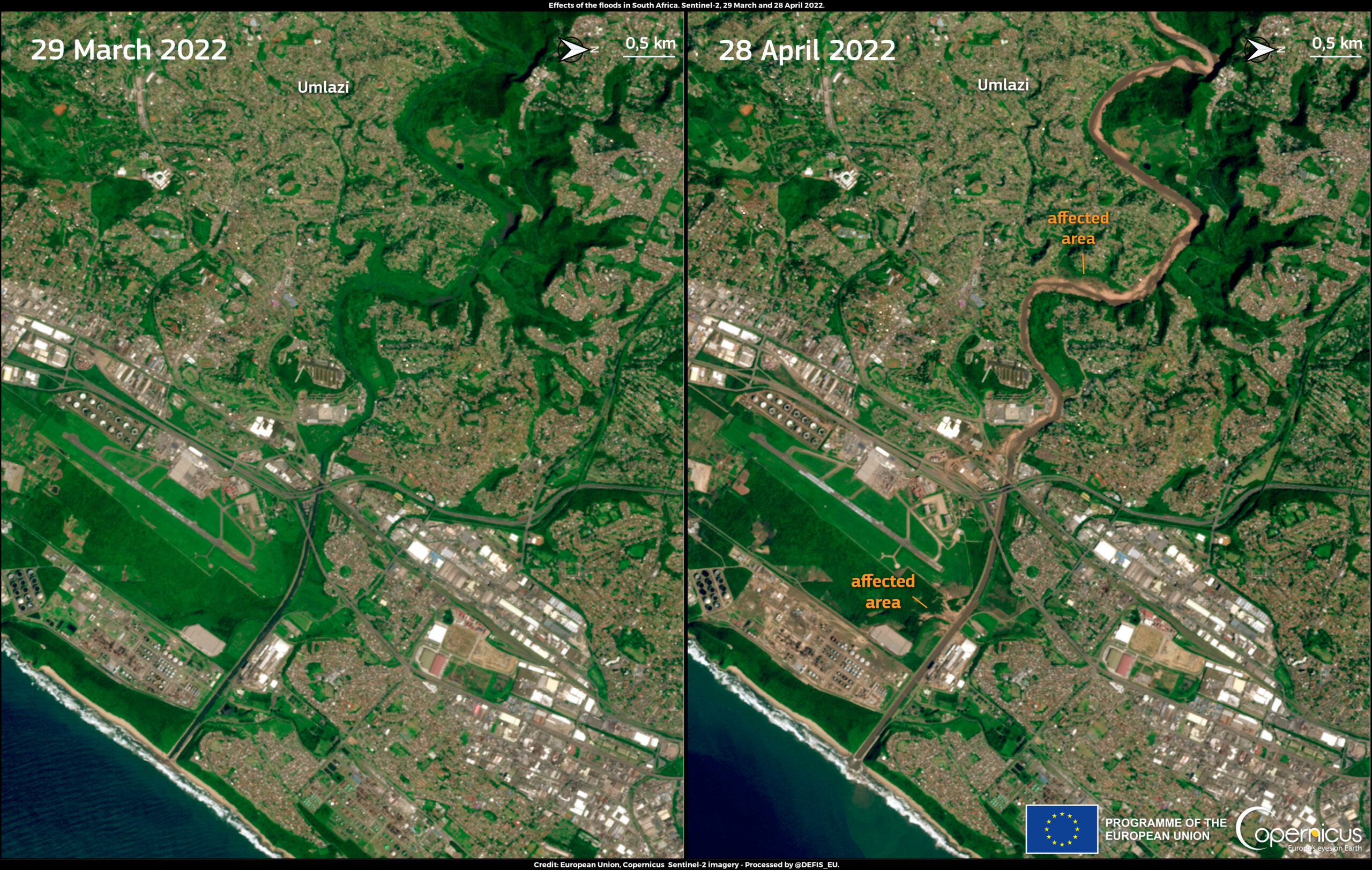
Image: European Union, Copernicus Sentinel-2 imagery — the April 2022 floods around Durban, KwaZulu-Natal, seen from orbit.
KwaZulu-Natal’s Own Floods, And A Bill That’s Still Being Argued Over
Watching Nepal’s rivers rise is difficult to do from KwaZulu-Natal without thinking of April 2022, and the flooding that has returned in the years since, most recently with a national disaster declared in January 2026. The April 2022 floods alone caused an estimated R7 billion in damage, affecting 826 companies and around 31,220 jobs, more than two-thirds of them in eThekwini. Roads, bridges, the Durban port and King Shaka International Airport were all disrupted. Guesthouses, tour operators and small businesses along the coast and inland lost stock, vehicles and, for weeks at a time, the ability to reach their own guests.
Government support did follow: cost-sharing grants through the dtic for rebuilding infrastructure and replacing machinery and vehicles, a multi-hundred-million-rand fund for roads and bridges, working capital grants and interest-free loans for stock replacement, and emergency funding for shelter, water and sanitation. That support has genuinely helped businesses get back on their feet, and it shouldn’t be understated.
But look closely at what almost every one of those schemes actually funds, and a pattern emerges: infrastructure, machinery, stock and buildings. Assets that broke. What is far harder to find is a straightforward scheme that compensates a small tour operator, guesthouse or travel business for the income it simply never earned while the roads were closed, the airport was disrupted and travellers stayed away, weeks or months of trade that vanished without a single window being broken. For a large, insured manufacturer, that gap can be fought in court; Toyota and several packaging companies have pursued multi-billion-rand lawsuits against the municipality and province to recover exactly this kind of loss. For a small tourism business with no legal budget and often no business interruption cover, there is no equivalent route. The infrastructure gets rebuilt. The lost season doesn’t get replaced by anyone.
Researchers tracking how extreme weather is disrupting South African tourism have flagged the same shortfall: a need for genuinely accessible disaster insurance and support that recognises lost trade, not only damaged assets, still doesn’t really exist for the small and mid-sized operators who make up most of KwaZulu-Natal’s tourism economy. This isn’t a complaint against the relief that has been provided. It’s a call to close the gap in it, because after 2022 and now January 2026, it is clear there will be a next flood, and the businesses that survive one season of lost income without help are the ones best placed to still be standing, and hiring, when the next storm passes.
Why This Matters, Wherever You’re Standing
Whether the water is rising in a Himalayan valley or along the Msunduzi and Umgeni rivers, the lesson is the same: preparation, honest and specific information, and support systems that cover the whole cost of a disaster, not just the bricks and machinery, are what determine how quickly people and businesses recover. Our thoughts are with everyone affected in Nepal, and with the many KwaZulu-Natal businesses still rebuilding from floods of their own. Booking your next trip, whether it’s a Drakensberg escape or further afield, through a licensed operator who takes safety planning seriously is one small way to travel a little wiser.
For more travel tips, safety updates and a look behind the scenes of our own KwaZulu-Natal tours, subscribe to our YouTube channel, @GoProfoundly.
Read More
- Al Jazeera: At least eight killed in Nepal flash floods that swept away villages, roads
- NPR: 8 dead, hundreds missing as Nepal avalanche triggers flash floods
- ICIMOD: Major flash flood sweeps through Nepal’s Rasuwa district
- ReliefWeb: Damage to KZN companies estimated at R7 billion
- Freight News: KZN and EC flood-damaged businesses thrown financial lifeline
- Global Government Forum: Should governments pay businesses for climate disasters?